|
Bromelia collection focussing on Tillandsia
Collection Tillandsia
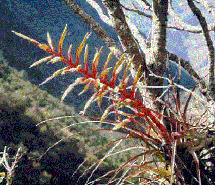
Tillandsia callichroma, Mexiko
Collection Tillandsia, Fam. Bromeliaceae: We have collected and propagated Tillandsias for more than 30 years. Apart from approximately 80 species of other Genera of Bromeliads we grow about 520 species of Tillandsia. 380 species were collected by ourselves in Mexiko, Peru, Bolivia, Argentina, Chile, Brasilia and Ecuador. The variability of many species is documented by the number of collection, locality and altitude, and we grow several clones of every variety to assure propagation by seeds ( most of the species are self infertile ). We take special care of the Subgenus Diaphoranthema. Only from T. usneoides we grow about 70 different origins. Seedlings exist from many species, some of them are older than 20 years. Seedlings and plants from vegetative propagation can be ordered by private collectors and Botanic Gardens. We found different new species of Bromeliads and some of them we described by ourselves. Besides these we grow some new and yet undescribed species from Peru and Bolivia in our collection. Many species, especially those of Neotropic foggy and humid mountain- forests as well as of the Atlantic rainforest of Brasilia, are endangered by forest destruction. We regret that we do not have greenhouses adjusted to grow and propagate species of cool and foggy forests. It´s a shame that in the rich industrial countries so little effort is made to save irretrievable plants, that Botanical Gardens lack the space and staff, whilst for business activities there are huge heated greenhouses even for plastic flowers and plant pots.
Collection of marsh- and waterplants:Apart from very frequent plants of humid areas there are some which are rare or very rare and therefore endangered. For instance Trapa natans, Cladium mariscus, Alisma gramineum, Aldrovanda vesiculosa, Potamogeton coloratus, Caldesia parnassifolia, Pilularia globulifera, Marsilea quadrifolia, Luronium natans, We try to grow and propagate also such rare species.
Marsh turtles:We confine ourselves to two species : the European marsh turtle Emys orbicularis and the Eastern painted turtle, Chrysemis picta picta from the eastern parts of the USA.Both species can be kept in an outside pond for the whole year ( for Chrysemis picta picta this holds only true for animals coming from a northern population, for instance the district of New York or Maine). The first mentioned species is a reptile that has become very rare in central and northern Europe, and we have to take care to guarantee its survival. The species mentioned last is of a graceful infatuate beauty. The red and black design of the margins of the carapax reminds us of the aestethic mysteries that emerge from some pictures of abstract art. It´s a miracle that such a creature of tropical elegance is able to live in the modest surroundings of a temperate climate.
Plants of the Pannonical climate zone:For a relatively short time wehave been dealing with plants of our region. In the eastern part of Austria, in the climate zone of the Pannonicum there exist a lot of interesting plants, worthwhile to be cultivated. Some of them flower until late autumn and give food to a lot of insectsfor example Apes, wasps, beetles and butterflies can be observed the whole summer. As examples we mention Verbascum, Dracocephalum, Iris, Lavatera, Dianthus, Echium, Aster, Jurinea, Echinops, Artemisia.
Native terrestrial Orchids:After clearing a presumably abundant vineyard completely covered with shrubs we were successful in settling some species of native orchids by seeding, species which were growing in the region in former times. Some of them can still be found in restricted areas. From seeding to the first flowering it takes 3 – 6 years (depending on the species). Surprisingly also western European species which do not normally live in the region can be settled by seeding, for example Orchis simia and Aceras anthropophorum. Within an area of less than 2000 m2 the following species grow and propagate generatively : Anacamptis pyramidalis, Ophrys holosericea, Himantoglossum adriaticum, Orchis militaris, Orchis tridentata. It was also possible to resettle Anacamptis pyramidalis which was a relatively frequent plant in our nearer region (Neilreich, Flora von Wien, 1881) and which was extinct completely due to agricultural and construction activities.
Winter resistant Bamboo:It is hard to believe that it is possible to grow a lot of species of Bamboo in our climate, mainly from the Genera Phyllostachys, Fargesia and Pleioblastus. They are foreign to our postglacial flora, but of peculiar attraction and their evergreen leaves is warming the mind on cold, dull winter days. Our collection includes about 100 planted species.We are interested to enlarge the collection by means of exchange..
Fruit culture of old sorts:When we bought an orchard in 1983, that was almost completely covered with shrubs, we found some old unspecified types of apricots. Some of the fruit trees were covered with Clematis vitalba, dead or senile. We reorganed the old trees and planted about 100 mainly self-grafted trees with high trunk (mostly old sorts).Attempt to cultivate two North-American fruit trees : An article in the Journal of the Austrian Garden Society (Österreichische Gartenbaugesellschaft, "Garten" 5/1999) paid attention to a species of fruits native in the Eastern USA, which already Red Indians had made use of. In spite of the active tourist traffic the fruit tree has not found the way into our gardens, though the tree is cultivated in Arboretes of European Botanical Gardens. Asimina triloba (named Pawpaw by Red Indians) is the only species of the tropic family of Annonaceae which has advanced to the temperate Zone of the USA. The elliptical fruits maturing in autumn offer a delicious aroma very similar to the fruits of the nearly related Cherimoya tree Annona cherimoya). In the USA nurseries offer about two dozen sorts of selections. We have imported some of them and try to graft them ourselves. The nursery Prascac offered little trees in pots some time ago, therefore we were already able to gather some fruits the last two years. Diospyros virginiana : In northern Italy Diospyros kaki prospers, the Khakitree native to Eastern Asia. The red tomato- shaped fruits are sold also in Austria in late autumn. Unfortunately this species is not winter- resistant north of the Alps. A substitute could be the fruits of Diospyros virginiana ( Persimone ), a tree native to North America. There are various fruit selections of this species, but it will take some years until we know if the fruit ripens enough in our autumn which is usually not so warm as in the USA.
We are convinced that the capitalistic- neoliberal economy has no future because it leads to increasing inequality and therefore causes social clashes. This economy consumes non renewable resources without paying any respect to the necessities of future generations.A change of mind (except among some minorities) is not in sight and probably a big catastrophe is necessary before there will be majorities against the present system of exploitation, exhaustion and waste. It is our principle to create a system of sustainable supply using food based on the ideas of Permaculture : a garden with vegetables and fruits, and sheep for milk. Our top priority is the conservation and promotion of endangered native animals and plants as well as the preservation of old agricultural systems. We take care of a meadow with native orchids, hedges with shrubs of the region and some artificial ponds for amphibians and rare waterplants. We are pleased about contacts to people with similar interests. Contact us at: Hromadnik@telering.at. Lieselotte and Helmut Hromadnik
Links:Österreichische Gartenbaugesellschaft, e-mail: oegg@oegg.or.at, http://www.oegg.or.atArche Noah, Verein zur Erhaltung der Kulturpflanzenvielfalt http://www.arche-noah.at Permakultur Austria e-mail: perma@mail.boku.ac.at, http://permakultur.at/ http://perma-web.de/ Deutsche Bromeliengesellschaft: roesslein-kirchberg@t-online.de, bromelie@aol.com Bromelientauschbörse: Mbroetzmann@snafu.de, http://www.snafu.de/~mbroetzmann/ NÖ Schafzuchtverband :1014 Wien, Löwelstr. 12, Tel.01/53441/8601, Fax:8609 Österreichische Kakteengesellschaft, e-mail: office@cactus.at, http://cactus.at/ Österreichische Orchideengesellschaft Schildkrötenfreunde Österreichs: andreas.budischek@europe.com, http://members.1012surfnet.at/schildi, e-mail: 113142.3232@compuserve.com Eurosolar: inter_office@eurosolar.org Argus, Verein für umweltfreundlichen Stadtverkehr, e-mail: service@argus.or.at, http://www.argus.or.at/argus/ Österreichischer Naturschutzbund e-mail: salzburg@naturschutzbund.at Deutsche Bambusgesellschaft, EBS-E.Weber@t-online.de
|